THE EXPANDED USE OF BIOFUNGICIDES AS A KEY STRATEGY TO MITIGATE AGRICULTURE-DRIVEN ANTIFUNGAL RESISTANCE IN ASPERGILLUS FUMIGATUS.
03/12/2025· ,,,,
Gabriel Felix da Silva
Luisa Rocca de Oliveira
Lanay Vasques Codulo
D. J. Silva
Paulo Cesar Ceresine
Resumo
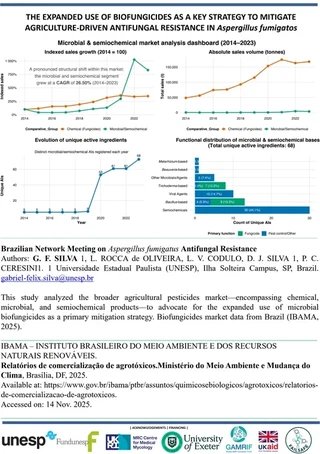
The emergence of azole-resistant Aspergillus fumigatus is a critical One Health challenge, driven largely by the widespread use of azole fungicides in agriculture. These agents exert strong environmental selection pressure, leading to cross-resistant strains that compromise clinical treatment of invasive aspergillosis. This study analyzes the broader agricultural pesticides market—encompassing chemical, microbial, and semiochemical products—to advocate for the expanded use of microbial biofungicides as a primary mitigation strategy. Biofungicides market data from Brazil (IBAMA, 2025) reveals apronounced structural shift within this market: the microbial and semiochemical segment grew at a CAGR of 26.50% (2014–2023), nearly double that of the chemical pesticides segment (14.76%). This rapid growth and the concurrent surge in unique active ingredient registrations signal a strong market transition towards low-resistance-risk alternatives. Within this biological segment, biofungicides constitute a substantial and growing portion (~22% of unique microbial active ingredients), dominated by Bacillus and Trichoderma strains. These agents employ complex, multi-site modes of action with no overlap with clinical azoles, presenting a low-risk resistance profile. The documented expansion and diversification of the biofungicide portfolio within the agricultural pesticides market provide a clear, evidence-based pathway for reducing environmental azole selection pressure, thereby preserving the efficacy of medical antifungals.
Tipo
Publicação
The Official Journal of Sao Paulo State Plant Pathology Association,, 51(4), 39
Situação
Revisado por pares
Acesso aberto
Antifungal Resistance
Biofungicides
Aspergillus Fumigatus
Azole Resistance
One Health
Pesticide Market

Autores
Graduando em Engenharia Agronômica
Sou graduando em Engenharia Agronômica na Faculdade de Engenharia de Ilha Solteira (FEIS/UNESP). Minha pesquisa busca entender como fungos e outros micro-organismos podem contribuir para uma agricultura mais sustentável: do aproveitamento do substrato pós-cultivo de cogumelos como biofertilizante a bioinsumos microbianos e compostos naturais com ação antifúngica. Participo de projetos com colaboradores nacionais e internacionais, com apoio do CNPq e da UK Research and Innovation.