Potential Of Papain In The Extraction Of Proteins From The Basidiomycete Pleurotus Ostreatus
01/11/2025· ,,
Gabriel Felix da Silva
Ana Maria Rodrigues Cassiolato
Sérgio Henrique Silva
Resumo
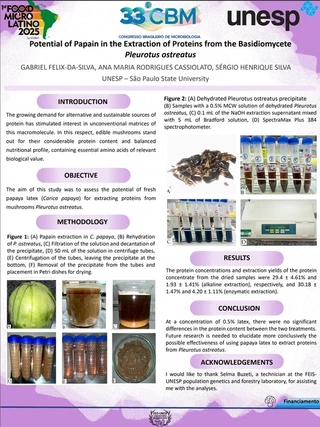
The growing demand for alternative and sustainable sources of protein has stimulated interest in unconventional matrices of this macromolecule. In this respect, edible mushrooms stand out for their considerable protein content and balanced nutritional profile, containing essential amino acids of relevant biological value. Pleurotus ostreatus, popularly known as shimeji, is cultivated on a large scale in Brazil and other tropical regions due to its adaptability and rapid growth. Its protein profile (15% and 30% of dry matter) combined with the presence of bioactive compounds makes it a promising candidate for the development of functional ingredients and nutraceutical applications. The aim of this study was to assess the potential of fresh papaya latex (Carica papaya) for extracting proteins from Pleurotus ostreatus. The mushroom used as raw material for the experimental trial was obtained from experiments at the Ilha Solteira Faculty of Engineering (FEIS-UNESP) campus II, dehydrated and crushed. The proteins were extracted in two ways: alkaline and enzymatic extraction. In the alkaline extraction (NaOH), the powder was suspended at pH 8, in a ratio of 1:10 m/v (mushroom/solution), under magnetic stirring at 40 °C for 45 minutes. After this stage, the suspension was filtered through organza cloth. The supernatant obtained was subjected to isoelectric precipitation, adjusting the pH to 3.5. The material was then centrifuged at 3,600 rpm at 25 °C for 15 minutes. The resulting precipitate was dried in an oven to obtain the powder concentrate. For enzymatic extraction to use the papain present in the latex, the latex was first extracted from the papaya (Carica papaya) and then 0.5 g was weighed out in natura for incorporation into the solution medium. For enzymatic extraction, the mushroom powder was suspended in distilled water at a ratio of 1:10 m/v (mushroom/solution) and 0.5% m/v (mass of papain/volume of solution) of fresh latex (P) was added. After this stage, the suspension was filtered, precipitated, centrifuged and dehydrated under the same conditions as the alkaline extraction. The extraction yield was determined based on the ratio between the mass of the precipitate obtained after dehydration and the initial mass of the mushroom used. The protein content was quantified using the Bradford method in the Population Genetics, Evolution and Forestry laboratory at FEIS-UNESP campus II. The protein concentrations and extraction yields of the protein concentrate from the dried samples were 29.4 ± 4.61% and 1.93 ± 1.41% (alkaline extraction), respectively, and 30.18 ± 1.47% and 4.20 ± 1.11% (enzymatic extraction). At a concentration of 0.5% latex, there were no significant differences in the protein content between the two treatments. Future research is needed to elucidate more conclusively the possible effectiveness of using papaya latex to extract proteins from Pleurotus ostreatus.
Tipo
Publicação
33º Congresso Brasileiro de Microbiologia 2025/MICROBIOLOGIA DE ALIMENTOS - 1st FoodMicro Latino, 33(204/2917-0), 1
Situação
Revisado por pares
Acesso aberto

Autores
Graduando em Engenharia Agronômica
Sou graduando em Engenharia Agronômica na Faculdade de Engenharia de Ilha Solteira (FEIS/UNESP). Minha pesquisa busca entender como fungos e outros micro-organismos podem contribuir para uma agricultura mais sustentável: do aproveitamento do substrato pós-cultivo de cogumelos como biofertilizante a bioinsumos microbianos e compostos naturais com ação antifúngica. Participo de projetos com colaboradores nacionais e internacionais, com apoio do CNPq e da UK Research and Innovation.