Microorganisms Quantification Of Honeys From The Native Stingless Bees (Tetragonisca Angustula) L.
01/11/2025· ,,
Gabriel Felix da Silva
Ligia Maria Manzine Costa
Ana Maria Rodrigues Cassiolato
Resumen
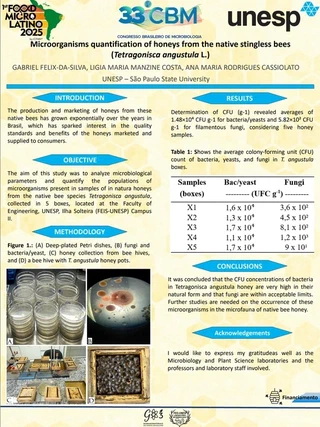
Native stingless bees are insects of the Order Hymenoptera belonging to the Family Apidae, of the clade Corbiculata, tribe Meliponinae, with predominant occurrence in the terrestrial tropics, Brazil being one of the tropical countries with the greatest occurrence and great diversity. The production and marketing of honeys from these native bees has grown exponentially over the years in Brazil, which has sparked interest in the quality standards and benefits of the honeys marketed and supplied to consumers. However, Brazilian legislation has standardized the physicochemical and microbiological parameters of honey for marketing purposes only based on the bee species Apis mellifera, justified by the high production and consumption of this species. It is therefore necessary to study this species for potential research applications, as a periscope of its raw materials such as wax, honeys and propolis, which can be applied from the medical field to agriculture, in multiple areas. The aim of this study was to analyze microbiological parameters and quantify the populations of microorganisms present in samples of in natura honeys from the native bee species Tetragonisca angustula, collected in 5 boxes, located at the Faculty of Engineering, UNESP, Ilha Solteira (FEIS-UNESP) Campus II, with production from November 2023 to February 2025, and the tests were carried out in the FEIS-UNESP microbiology laboratory. The T. angustula honeys were collected in the morning, and the hives were removed from the boxes using gloves and 70 GL alcohol. They were packed in plastic bags and transported to the laboratory where the honeys were collected from the wax jars by gravity and then filtered and filled into amber glass jars with bung sterilized for 24 hours at 60°C. These were stored in a refrigerator for +- 4℃ until they were submitted for analysis. For the microbiological analyses, 25g aliquots of the honey samples were homogenized in 225 mL of deionized water containing 0.1% peptone to form a diluent with a concentration of 10-1. From this, serial dilutions were made (10-2and 10(-) ³), of which 1 mL of each dilution concentration was used in the depth plating methodology, using Potato Dextrose Agar culture medium for counting Bacteria / Yeasts and Filamentous Fungi. Incubation took place in an oven at 27+-0.2 °C for 48 hours and colonies were counted every 12 hours. The determination of CFU g-1revealed averages of 1.48×10⁴ CFU g-1for bacteria/yeasts and 5.82×10² CFU g-1for filamentous fungi, considering five honey samples. The experimental test for evaluating CFU g-1of honeys presented relevant data, and the information is valid for characterizing the honeys of native bees. The incidences of both bacteria/yeasts and mycelial fungi showed a difference in the time it took to colonize the culture medium, with bacteria being faster and fungi slower when evaluated in terms of concentrations, and showing population diversity and growth speed, a survival differential in their habitats.
Tipo
Publicación
33º Congresso Brasileiro de Microbiologia 2025/MICROBIOLOGIA DE ALIMENTOS - 1st FoodMicro Latino, 33(204/2863-0), 1
Estado
Revisado por pares
Acceso abierto

Autores
Estudiante de Ingeniería Agronómica
Soy estudiante de Ingeniería Agronómica en la Facultad de Ingeniería de Ilha Solteira (FEIS/UNESP), Brasil. Mi investigación busca entender cómo los hongos y otros microorganismos pueden contribuir a una agricultura más sostenible: desde el aprovechamiento del sustrato poscultivo de hongos comestibles como biofertilizante hasta bioinsumos microbianos y compuestos naturales con acción antifúngica. Participo en proyectos con colaboradores nacionales e internacionales, con apoyo del CNPq y de UK Research and Innovation.