IUMS 2026: highlights from three days in Lisbon

 Official IUMS 2026 artwork.
From 4 to 6 November 2026, the Biennial Congress of the International Union of Microbiological Societies (IUMS 2026) brought researchers from around the world to Lisbon under the theme Beyond the Microscope: AI & Innovation in Microbiology. These are highlights from the sessions I attended.
Day 1 (4 November)
Opening sessions (Auditorium I)
- Drew Weissman (University of Pennsylvania), 2023 Nobel Prize in Physiology or Medicine: Nucleoside-Modified mRNA-LNP Therapeutics.
- Joseph Heitman (Duke University): On the Evolution of Fungal Pathogenesis: Cryptococcus as a prism for discovery.
- Claudia Sala (Fondazione Biotecnopolo di Siena): Human monoclonal antibodies to tackle antibiotic-resistant bacteria.
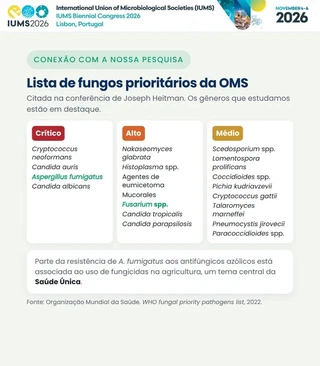
Heitman’s lecture featured the World Health Organization fungal priority pathogens list, which includes Aspergillus fumigatus (critical group) and Fusarium spp. (high group), the two genera studied in our projects.
One Health (Auditorium III+IV)
Oral presentations on antimicrobial resistance at the interface between people, animals and the environment, such as enterococcal resistance in households with companion animals and targets for broad-spectrum antivirals.
Epidemiology and Public Health (Auditorium I)
Genomic and metagenomic surveillance of outbreaks and emerging threats, closing with Célia Manaia (Universidade Católica Portuguesa): Environmental Antimicrobial Resistance: Both Symptom and Risk.
Day 2 (5 November)
Opening sessions (Auditorium I)
- Emmanuelle Charpentier (Max Planck Unit for the Science of Pathogens), 2020 Nobel Prize in Chemistry: applications of CRISPR-Cas genome editing.
- Wendy Barclay (Imperial College London): A host factor required for influenza virus replication could provide a target for novel approaches for control.
- Miguel Prudêncio (GIMM, Lisbon): co-infections and the liver stage of malaria.
Food Microbiology and Safety (Auditorium II)
Non-conventional and brewing yeasts, Ganoderma lucidum nutraceuticals, fermented foods and feeds, coliphages in poultry and Listeria monocytogenes persistence in food production.
Plant Pathogens and Human Well-being (Auditorium II)
- Pedro Crous (Westerdijk Fungal Biodiversity Institute): Polyphyly of Fusarium sensu Wollenweber. Correct species identification is the first step in studying the control of pathogens such as Fusarium verticillioides. A useful public resource is the Fusarioid-ID database.
- Susanne Zeilinger (Universität Innsbruck): Chemical communication shapes fungal biocontrol: insights from Trichoderma atroviride.
- Julia Gallego Villanueva et al. (University of Cádiz): MALDI-TOF for identifying fungal phytopathogen species and strains.
An evening at the Lisbon Academy of Sciences (5 November)
At the end of the second day, the social programme gathered participants at Largo Luís de Camões, in Chiado, for a walk to the Lisbon Academy of Sciences. Founded in 1779, the Academy has been housed in the former Convent of Jesus since 1834. The evening ended with fado in the Salão Nobre, among the shelves of the convent’s old library.
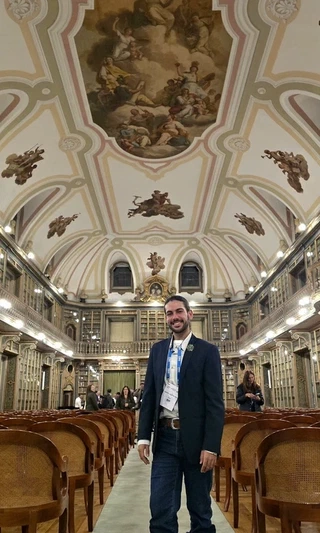
The Academy’s motto sums up the purpose of science communication well: Nisi utile est quod facimus, stulta est gloria (“If what we do is not useful, glory is in vain”).
Day 3 (6 November)
The final day placed artificial intelligence at the core of the programme. In the AI’s Global Impact session, Tiago Costa (Imperial College London) presented AI Recapitulates Experimental Discovery of a Novel Gene Transfer Mechanism. The day also included sessions on Big Data, AI in clinical microbiology and One Health, and the panels Will AI win? and Is data dead?.
Our posters (6 November)
On the final day, I presented our work in the poster session.
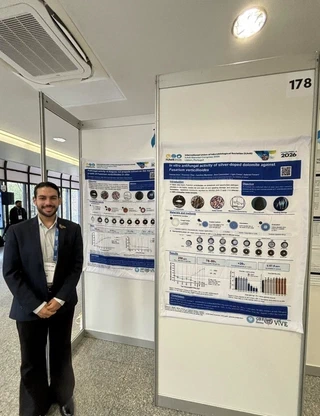
- Silver-doped dolomite against Fusarium verticillioides (session AS12): the composite inhibited the fungus in a dose-dependent way from 175 ppm Ag⁺ (EC₅₀ ≈ 258 ppm; 78–80% inhibition at 525–700 ppm). Pure dolomite did not inhibit the fungus, showing that the effect comes from silver. View poster
- Alagoas red propolis against F. verticillioides (session AS12): the extract inhibited the fungus at every concentration tested (relative IC₅₀ 3.99–5.74 ppm), with maximum inhibition of about 78% from 75 ppm, in two independent assays. View poster
- Microbial consortia and organic fertilization in Astronium fraxinifolium seedlings (session AS18, led by Philippe Silva): composted sewage sludge was the main driver of seedling quality, and inoculation with Bacillus subtilis and Rhizophagus clarus increased root colonization and water use efficiency. View poster
Many thanks to the co-authors, advisors and research groups at FEIS/UNESP.
What I take back to our research
Antimicrobial resistance and One Health ran through all three days. This is the same thread as our work on Fusarium verticillioides and Aspergillus fumigatus: finding alternatives to fungicides that protect crop production without increasing risks to human health. Our three studies presented at the congress are on the Publications page.
Photos of slides and talks were not reproduced, in line with the congress photography rules. Titles and speakers are listed in the official programme.
