Three studies at IUMS 2026 in Lisbon
18/10/2026·
Gabriel Felix da Silva
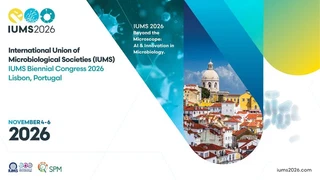 Official IUMS 2026 artwork.
From 4 to 6 November 2026, I’ll be at IUMS 2026, the biennial congress of the International Union of Microbiological Societies, in Lisbon, Portugal. This year’s theme is Beyond the Microscope: AI & Innovation in Microbiology.
I’m part of three studies developed at UNESP.
The first two look for alternatives to conventional fungicides against Fusarium verticillioides, a fungus that attacks maize and can produce mycotoxins:
- Dolomite–silver composite: an abundant, low-cost mineral impregnated with silver, tested against the fungus in the laboratory.
- Red propolis from Alagoas: a Brazilian natural product, evaluated at different concentrations with dose-response curves.
The third one is in the Microbes for Sustainable Agriculture session:
- Microbial consortia and organic fertilization in Astronium fraxinifolium seedlings: composted sewage sludge mixed with sugarcane bagasse was combined with the bacterium Bacillus subtilis and the mycorrhizal fungus Rhizophagus clarus. We evaluated seedling growth, quality and water use. The study is led by Philippe Silva, in a partnership between FEIS/UNESP and FCA/UNESP in Botucatu.
Behind-the-scenes updates will be on Instagram, and the abstracts will be added to the Publications page after the event.
More about the congress: iums2026.com.

Authors
Undergraduate Student in Agronomic Engineering
I am an undergraduate student in Agronomic Engineering at the School of Engineering of Ilha Solteira (FEIS/UNESP), Brazil. My research aims to understand how fungi and other microorganisms can contribute to more sustainable agriculture: from the use of spent mushroom substrate as a biofertilizer to microbial bio-inputs and natural compounds with antifungal properties. I take part in projects with national and international collaborators, with support from CNPq and UK Research and Innovation.